



Guides
Rebind euro savings in 2026: rates, fees and risks
How Rebind euro savings work, what the advertised 5% means, how fees and deposit protection differ from a bank, and what to check before depositing.
On this page
Rebind offers a way to earn a variable yield on euro stablecoins through decentralized finance (DeFi). It is not a bank savings account: the rate can change and your capital is at risk. This guide examines its public offer, fees and risks, rather than ranking every way to earn interest on euros.
This is a review of public documentation, not a report of a tested deposit or withdrawal. Rebind signup links below are referral links.
What is Rebind, and how do euro savings work?
Rebind's website advertises euro savings alongside an IBAN and a Visa card. Its terms, sections 3.3–3.4, distinguish the euro stablecoin from the DeFi strategies used to generate yield. Holding a token and depositing it into a lending strategy are different exposures.
Borrowers pay for access to liquidity. Your return depends on the selected strategy, borrowing demand, fees and any incentives. Collateral does not remove the risk of losses. There is no basis for assuming that removing a bank automatically produces a higher or safer return.
What does “up to 5%” actually mean?
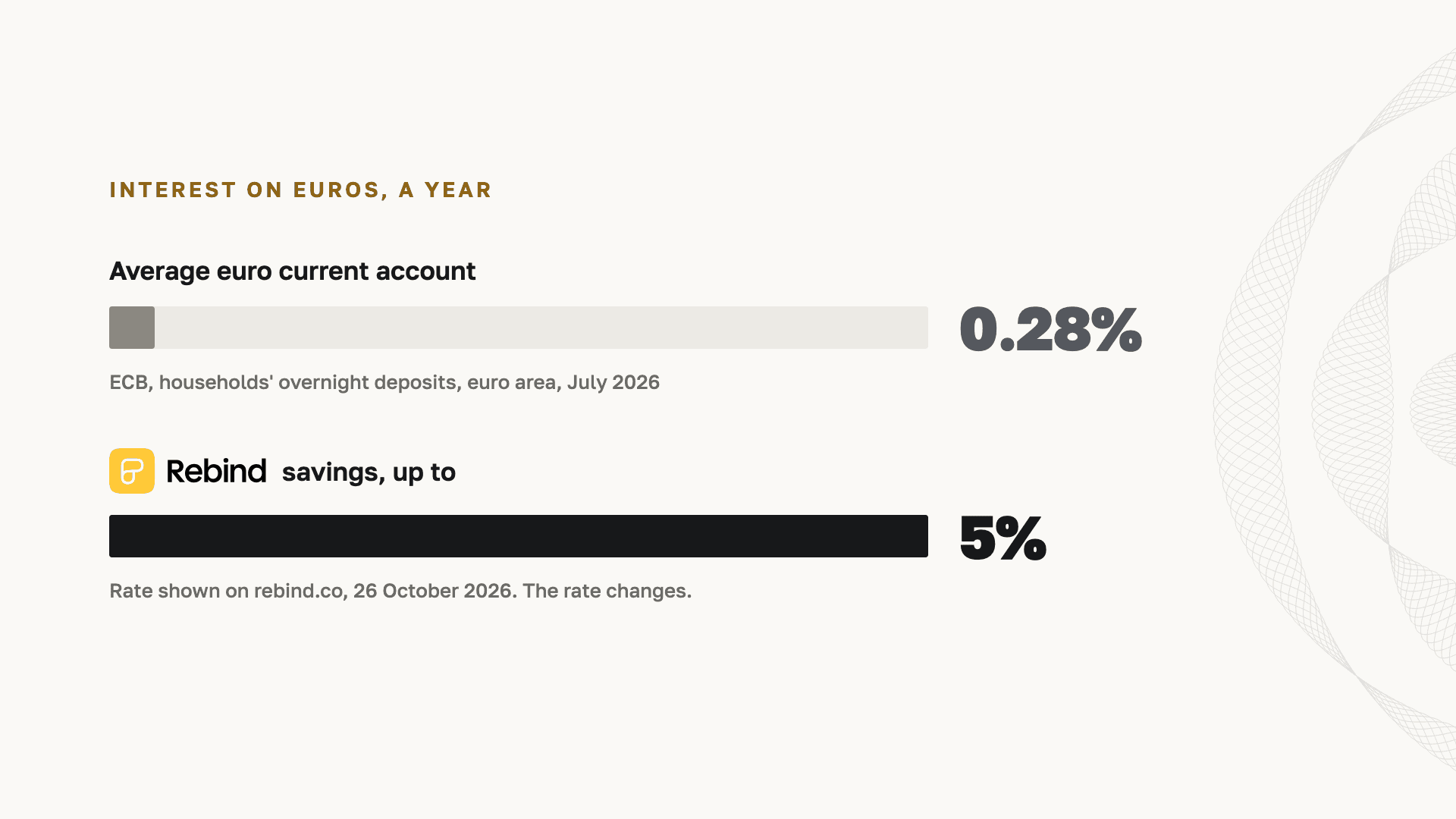
On 4 November 2026, Rebind advertises up to 5% annually, with no lock-up. This is an advertised maximum, not a fixed offer to every saver. Check the rate shown for your chosen strategy, whether it is APR or APY, and whether any part is temporary or conditional.
For scale, €1,000 earning a constant 3% for one year would produce €30; at 5%, €50. These are simple illustrations before tax, without compounding or additional costs, and assume no capital loss. They are not measured Rebind returns. A changing rate changes the result.
Rebind vs a bank savings account
A bank savings account and a euro stablecoin strategy can both display a euro balance, but that does not make their protections equivalent.
- Bank deposit: eligible EU deposits have protection up to €100,000 per depositor per bank, subject to scheme rules. Check the bank, product and applicable scheme; see the European Commission's explanation.
- Rebind savings: its disclaimer says stablecoin balances are not bank deposits and yield involves third-party DeFi protocols. Deposit protection does not cover these balances.
A euro peg is a target, not a promise that your balance cannot lose value. Issuer, reserve, smart-contract and liquidity failures can affect access to funds or their value. Compare protection and access to money before comparing headline rates.
Fees, withdrawals and country eligibility
Rebind says its displayed savings rate includes its commission. That does not establish the total cost of every route into or out of a strategy. Before depositing, check the transaction preview, partner charges, conversion costs, withdrawal conditions and minimums. “No lock-up” does not establish that every withdrawal will settle immediately during market stress.
There is an unresolved availability mismatch: the homepage promotes use in more than 40 countries, while section 3.1 of its terms says the app is available only within the EU. Confirm your residency and eligibility for the account, card and savings strategy with Rebind before transferring money; do not rely on “wherever you live.”
What to check before depositing
- Identify the stablecoin, issuer, network and lending strategy you will actually use.
- Check the current net rate and what can change it.
- Read the loss scenarios and withdrawal restrictions, including how to recover access without the app.
- Confirm country eligibility and the costs shown before signing a transaction.
- Keep records for local tax reporting. An advertised yield is not an after-tax return.
If you also trade volatile assets, evaluate those separately from savings. Flicker's profit and loss calculator models a trade's entry and exit; it does not measure stablecoin or lending-protocol safety.
Sources checked on 4 November 2026: Rebind's website, terms and disclaimer, and the European Commission's deposit-guarantee guidance linked above. Rates, terms and availability can change.
Analysis, not advice. Prices move; you can lose money.
- euro savings
- earn interest on euros
- EUR stablecoin
- Rebind
- IBAN
- savings account alternative
You might also like

Guides8 min read
How to get free crypto in 2026: what actually pays
Every real way to get free crypto in 2026, with honest numbers: sign-up bonuses, learn-and-earn, airdrops, faucets, and the offers that never pay.
Guides9 min read
Trading apps for crypto, stocks and forex in 2026: which read all three
One app for Bitcoin, a few stocks and EUR/USD: what each kind of app does with all three markets, where it stops, and what to check first.

Guides9 min read
Crypto alert apps in 2026: which kind fits how you trade
Crypto alert apps compared by use case: who picks the level, what the alert watches, how it reaches you and what is free. Plus an alert that carries its stop.